5.500.000+ parts in stock
Fast delivery



The Domsel Seal AC is a high-performance oil seal for rotating shafts where leakage and contamination must be controlled on both sides. Unlike a standard single-lip oil seal that mainly keeps one medium in or keeps dirt out, the seal AC design uses two sealing lips facing opposite directions. This makes it a strong choice when you need true media separation, for example keeping oil or grease inside a housing while simultaneously blocking water, dust, or process media from the outside. Because Domsel uses a springless lip concept, the Domsel Seal AC can offer stable sealing behaviour with lower friction than many traditional oil seals, especially in applications with higher shaft speeds and pressure fluctuations.
What sets the Domsel Seal AC apart from conventional oil seals is how the sealing force is created. Many oil seal designs rely on a spring-loaded lip to maintain radial contact pressure, but the Domsel concept uses specially shaped elastomer lips that create the sealing effect through their geometry and elasticity. These lips are supported by a robust metal reinforcing ring that stabilizes the seal in the bore and helps the lips maintain their position under load.
Because the Domsel Seal AC features two lips, one lip is oriented to retain the internal medium while the other is oriented to block external ingress, which is the core reason AC seals are used for media separation. Between the lips there is typically space for a grease reservoir, supporting long-term lubrication and helping reduce the risk of dry running at the lip contact zone. The springless design and controlled lip loading can also make the Domsel Seal AC gentler on the shaft in many applications, helping reduce aggressive groove formation compared with high-contact-pressure designs, provided the shaft finish, lubrication, and alignment are correct.
The Domsel Seal AC is typically selected when a standard oil seal becomes a weak link, either because the duty cycle is more demanding or because you need a seal that protects against leakage and ingress at the same time. In industrial drives and gearboxes, a seal AC oil seal helps retain lubricants reliably while preventing dust or washdown water from entering bearing zones. In pumps, mixers, and general process equipment, AC seals are useful when you must keep internal product or lubricant separated from the outside environment, especially where splash, cleaning, or ambient particles are present. In fans, blowers, and other rotating equipment, the combination of stable sealing and lower friction can help control operating temperatures and support longer service intervals.
The Domsel Seal AC is also relevant in hygienic machinery such as food and pharma equipment where contamination control is critical and where material selection and housing choices may be required. In these environments, the ability of AC seals to maintain separation between two sides is a practical advantage, but performance still depends on good installation practice, correct shaft condition, and selecting a compatible elastomer for the actual media and cleaning chemistry.
Domsel Seal AC oil seals are available in several elastomer options, and the right choice depends on temperature, the sealed medium, cleaning chemistry, pressure/speed, and the required service life. NBR is the standard option for mineral oils and greases thanks to its good wear resistance and cost-effectiveness, but it has limited high-temperature capability and more modest chemical resistance. HNBR is a common upgrade when NBR hardens too quickly or when the duty cycle is tougher: it offers improved heat aging, better ozone resistance, and stronger performance in many oil-based applications, while still remaining relatively practical in cost compared with premium compounds. For higher temperatures and broader chemical compatibility, FKM (Viton®) is often the go-to choice, especially for fuels, solvents, and many process media, although it can be less flexible at low temperatures and typically costs more than NBR/HNBR.
If the environment involves hot water, steam, or frequent washdown and CIP conditions, EPDM is usually the better match because it performs well with water-based media and steam, but it is generally not suitable for oils and greases. VMQ (silicone) is valued for low-temperature flexibility and a wide temperature window, yet it is typically less wear-resistant in harsh rotary duty and should be chosen when conditions are well controlled. When even FKM is not enough, particularly in aggressive chemical service or high-purity applications, FFKM becomes the premium option, offering maximum chemical resistance and excellent high-temperature performance at a significantly higher cost. For special cases, PTFE versions may be available on request, delivering high chemical inertness and temperature capability with low friction, but they require a very smooth shaft finish, stable alignment, and careful installation.
|
Material |
Temperature Range (°C) |
Key Properties |
|
NBR (Nitrile Rubber) |
-20 to +100 |
Resistant to oil, grease, and water; cost-effective; moderate chemical resistance |
|
HNBR |
-30 to +150 |
Improved heat aging and oil resistance vs NBR; better ozone resistance; higher cost; less chemical range than FKM |
|
FKM (Viton®) |
-30 to +200 |
High chemical and heat resistance; suitable for aggressive media; less flexible in cold |
|
FFKM |
-20 to +250 (varies) |
Maximum chemical resistance; high temp capability; premium choice for extreme chemicals; very high cost |
|
EPDM |
-40 to +150 |
Excellent steam and water resistance; not suitable for oils; good for CIP applications |
|
VMQ (Silicone Rubber) |
-50 to +200 |
Wide temperature tolerance; soft and low compression set; not very wear-resistant |
|
PTFE (Teflon) |
-60 to +250+ |
Extremely high chemical and temperature resistance; hard material; needs smooth shaft |
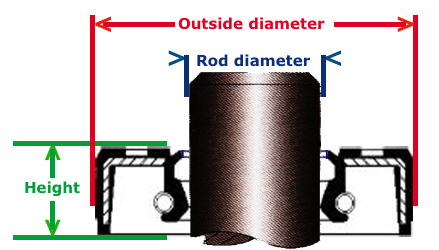
Selecting the correct Domsel Seal AC is about matching both dimensions and material to the real operating conditions. For sizing, you need the shaft diameter (d), housing bore diameter (D), and the seal width (B). Many Domsel AC seals follow standard rotary shaft seal dimension families associated with DIN 3760 and ISO 6194, which helps when replacing an existing oil seal, but it is still essential to verify actual hardware dimensions because wear, damage, or tolerance drift in the bore can compromise fit.
From a tolerancing standpoint, a common engineering approach is to keep the shaft within an h11 tolerance range and the housing bore within an H8 tolerance range, although exact fits can depend on diameter range, housing material, and design constraints. Shaft surface condition matters just as much: for many elastomer lip seals, a typical target for roughness is around Ra 0.2–0.8 μm, and you want to avoid spiral marks that could pump fluid. Installation details also matter, especially protecting the lips during assembly and ensuring the seal is pressed in square.
Material selection should then reflect temperature (continuous and peak), the medium (oil, grease, water, chemicals, cleaning agents), and the severity of pressure and speed. If you are searching for oil seals by dimension, the Domsel Seal AC is often a good candidate when you want a direct dimensional replacement but need better two-sided protection than a basic oil seal can deliver. For demanding pressure conditions, keep in mind that higher pressure capability is configuration- and application-dependent, and near the upper limits additional retention features and a robust lubrication strategy become increasingly important.
In summary, the Domsel Seal AC is a high-performance sealing solution designed to meet the rigorous demands of the machine building industry. Its reduced frictional moment, impressive pressure and temperature resistance, high chemical resistance, and accurate media separation capabilities make it a top choice for various applications. Trust in the Domsel Seal AC for your sealing needs and experience the benefits of a superior sealing solution in your rotating machinery.
Did you not find what you were looking for? take a look at our other domsel seals or get in touch!
The Domsel AC is designed to seal a rotating shaft while controlling both directions at once: it helps keep internal lubricants in place while preventing external contamination from entering, ideal for media separation.
The AC has two lips facing opposite directions for separation and two-sided protection. The AB typically has two lips oriented in the same direction to strengthen sealing on one side (often chosen when the internal side is the priority, such as pressurized media).
NBR is commonly used for mineral oils and greases. If temperatures are higher or the medium is more chemically aggressive, FKM is often a better fit.
Generally no, EPDM is strong in water/steam and some cleaning environments, but it is often not compatible with oils and greases. Use EPDM when the sealed media and the environment make it the right match.
In many double-lip setups, grease between the lips supports lubrication and can extend service life by reducing dry running risk. It’s a practical measure, especially in harsh environments or long service intervals.