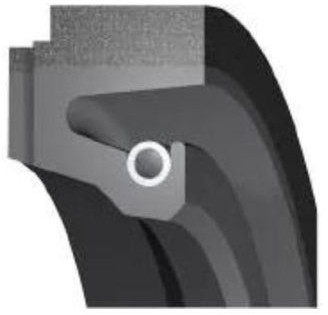

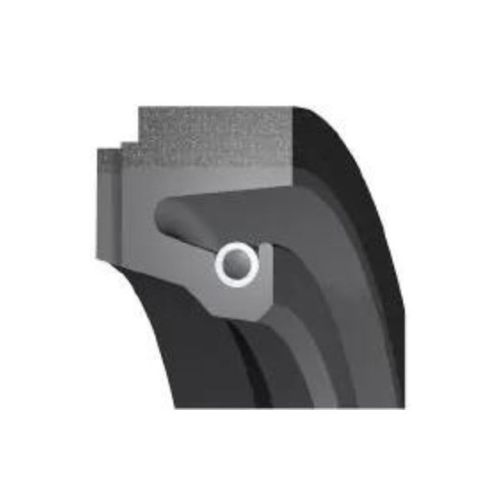
From a construction standpoint, the Q13 oil seal belongs to the category of fabric-reinforced oil seals. The seal consists of an elastomer sealing lip that is continuously pressed against the shaft by means of a garter spring. This spring ensures a stable sealing pressure, even when slight shaft movements or wear occur during operation. The outer side of the seal is made of a rubber-impregnated fabric reinforcement. This reinforcement provides dimensional stability and makes the seal particularly suitable for large diameters and for housings with a less-than-perfect surface finish or split constructions. The oil seal Q13 is specifically designed for applications with increased housing surface roughness, where standard oil seals do not provide sufficient sealing reliability. In many versions, the Q13 is supplied as a split seal, allowing installation without fully dismantling the shaft. All components of the Q13 oil seal are corrosion-resistant, making it suitable for use in damp or corrosive environments. In addition, Q13 oil seals are equipped with lubrication grooves that contribute to an even distribution of grease or oil along the sealing lip, thereby extending the service life of the seal.
Q13 oil seals are mainly used in heavy industrial installations where standard seals are no longer sufficient. Typical applications include large gearboxes, rolling mills, paper machines, wind turbines, marine drive systems and heavy-duty pumps. In these types of applications, contamination, vibration and thermal loads often play a significant role. The oil seal Q13 is well suited to withstand these conditions thanks to its mechanically stable construction and high wear resistance. The split design also makes this seal particularly suitable for installations where shaft disassembly is complex or time-consuming. As a result, maintenance can be carried out more quickly and downtime is kept to a minimum.
The Q13 oil seal is available in various elastomer versions, selected according to the medium and operating temperature. In most applications, NBR is chosen because this material offers good resistance to mineral oils and greases, along with good wear resistance and elasticity up to approximately 100 °C. When higher temperatures or more aggressive lubricants are involved, FKM is a suitable choice. This material provides excellent heat and chemical resistance and remains stable up to approximately 200 °C, although it is less flexible at low temperatures and generally more expensive than NBR. For applications where both mechanical load and temperature are critical factors, HNBR is also available on request. This material combines the elasticity of NBR with improved resistance to heat, ozone and ageing. The fabric-reinforced outer layer is always matched to the selected elastomer, ensuring that mechanical strength and material compatibility are maintained.
|
Material |
Temperature range |
Key properties |
|
NBR (Nitrile rubber) |
approx. –30 °C to +100 °C |
Good wear resistance and elasticity, suitable for mineral oils and greases, cost-effective and widely applicable. Less suitable for high temperatures, ozone or aggressive chemicals. |
|
FKM (Viton®) |
approx. –20 °C to +200 °C |
Excellent heat and chemical resistance, suitable for synthetic oils and aggressive media, long service life at high temperatures. Less flexible at low temperatures and higher material cost. |
|
HNBR |
approx. –30 °C to +150 °C |
Improved mechanical strength compared to NBR, good resistance to heat, ozone and ageing, suitable for dynamically loaded applications. Less chemically resistant than FKM. |
Compared to the Q10 oil seal, the Q13 is designed as a more maintenance-friendly and versatile variant within the same family of fabric-reinforced seals. Both types use a fabric-reinforced rubber body with an elastomer sealing lip and a garter spring, and both are intended for large shaft diameters and heavy-duty industrial applications.
The key differences are in execution and service concept. The oil seal Q10 is typically used as a robust, fabric-reinforced seal for very demanding environments with high contamination and wear, but it is generally installed as a conventional, endless ring. The Q13 rotary shaft seal, by contrast, is available in split form and is equipped with lubrication grooves. This makes the Q13 easier to replace without dismantling the shaft and better suited to applications where relubrication and reduced downtime are important.
In practice, the Q10 type is often chosen when maximum robustness and wear resistance are required and planned downtime is acceptable for seal replacement. The oil seal Q13 is preferred where similar heavy-duty performance is needed, but with additional focus on easy installation, in-situ replacement and the possibility of regular relubrication.
Selecting the correct Q13 oil seal starts with accurately determining the dimensions and operating conditions. The shaft diameter and housing are selected in accordance with common standards such as ISO 6194 or DIN 3760, with the shaft typically within ISO h9 tolerance and the housing within H8. In addition, shaft surface roughness, hardness and circumferential speed play an important role in determining the service life of the seal. Material selection is based on temperature, type of lubricant and any chemical exposure. For standard oil and grease applications, NBR is often sufficient, while FKM or HNBR is selected for higher temperatures or more demanding operating conditions. For split Q13 oil seals, installation is also critical: correct axial retention and positioning are essential to ensure reliable sealing. The oil seal Q13 is intended for unpressurized to lightly pressurized applications, with a maximum unpressurized pressure of approximately 0.05 MPa and a maximum circumferential speed of around 20 m/s. The maximum values must always be evaluated in conjunction with all other operating conditions.
If you would like more information about this oil-seal or you don't know what size or material you should have, please feel free to contact us.
The main difference is the fabric-reinforced construction and heavy-duty design of the oil seal Q13, making it suitable for large shafts and demanding industrial applications.
The Q13 is primarily intended for unpressurized or lightly pressurized applications and is not designed for high system pressure.
Yes, many Q13 oil seals are supplied in split versions, allowing installation around a fixed shaft.
The Q13 is typically available in NBR, FKM and HNBR, depending on temperature, medium and load.
Yes, the robust and wear-resistant design makes the oil seal Q13 highly suitable for applications involving dust, dirt or other contaminants.
Didn't find the right Oil Seal Q13 - Rotary Shaft Seal?
Complete the form below and we will help you!