5.500.000+ parts in stock
Fast delivery


A Garlock PS-Lip Gylon® is the dynamic sealing element that runs directly against a rotating shaft. The lip is made from a modified PTFE material and is supplied separately, without the complete metal housing of a PS-SEAL®. This makes the PS-Lip suitable for customer-specific housings, existing sealing arrangements and machine designs in which a complete standard rotary shaft seal cannot be installed.
The actual performance of a Garlock PS-Lip depends on more than the lip material alone. The housing construction, preload, shaft condition, operating temperature, pressure, speed and lubrication all influence friction, heat generation, wear and sealing behaviour. A loose PS-Lip must therefore always be considered as part of the complete sealing system.
Conventional radial shaft seals are commonly manufactured from elastomers such as NBR or FKM. These materials are suitable for many general industrial applications, but their operating range may become restrictive when the seal is exposed to aggressive chemicals, high or low temperatures, vacuum, limited lubrication or abrasive particles.
A Garlock PS-Lip can provide an alternative in pumps, mixers, agitators, compressors, screw conveyors, dosing equipment and other rotating machinery. Depending on the selected GYLON® material and the complete sealing design, the lip may be used in chemical processing, food and beverage production, pharmaceutical equipment and other demanding industrial processes.
Pressure and shaft speed should not be assessed separately. The combination of pressure and circumferential speed affects frictional heat and wear at the sealing contact. For this reason, the suitability of a PS-Lip must be evaluated using the complete operating profile rather than a single maximum value.
Garlock offers different modified PTFE lip materials for different operating conditions. The best material is determined by the dominant load in the application. A material intended for lubricated operation is not automatically the best choice for dry running, while a material developed for hygienic processes may be less suitable for strongly abrasive media.
|
Material |
Composition |
Typical application direction |
|
GYLON® Black |
PTFE with graphite |
Lubricated applications requiring low friction and good wear resistance. |
|
GYLON® White |
PTFE with barium sulphate |
Food, pharmaceutical and chemical processes where the selected product has the required compliance documentation. |
|
GYLON® Blue |
PTFE with microspheres |
Dry-running or start-stop conditions, hygienic processes and applications with increased shaft movement. |
|
GYLON® F |
Modified PTFE with Econol/polyimide |
Vacuum and applications with limited lubrication. |
|
GYLON® KF |
Modified PTFE with carbon fibre |
Dry-running applications requiring increased mechanical strength and wear resistance. |
|
GYLON® MS |
Modified PTFE with molybdenum disulphide |
Abrasive powders, slurries and media containing solid particles. |
Garlock lists a broad temperature range for the PS-SEAL® material family, typically from approximately -90 °C to +260 °C. This is a material guideline rather than a guaranteed operating limit for every PS-Lip application. Frictional heat, pressure, speed, medium and the surrounding sealing construction can reduce the usable range.
Food or pharmaceutical suitability should always be confirmed for the exact lip material and product supplied. A general material name or colour is not a substitute for the required FDA, EC 1935/2004, USP or application-specific documentation.
When replacing an existing Garlock lip, first check whether a MEC01 number is visible on the old part, drawing, machine documentation or purchase history. Enter this number in the Garlock Number filter to locate the corresponding product directly.
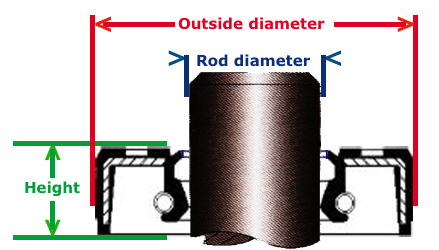
When the Garlock number is not available, selection starts with the main dimensions.
|
Filter |
Meaning |
|
Inside diameter |
The nominal shaft diameter on which the lip operates. |
|
Outer diameter |
The outside dimension required for the housing or support arrangement. |
|
Height |
The axial width of the loose sealing lip. |
|
Material |
The GYLON® compound selected for lubrication, dry running, vacuum, hygiene or abrasion. |
The measured dimensions alone are not sufficient for a completely new design. The designer must also determine the required lip preload, installation method, static sealing arrangement and retention of the lip under pressure. Sharp edges and unsuitable installation tools can damage the relatively thin PTFE lip during assembly.
The shaft surface is an active part of the sealing system. Surface roughness, hardness, roundness, concentricity and machining direction influence how the lip runs in and how stable the sealing contact remains. Spiral machining marks can transport fluid underneath the lip and cause leakage even when the material and dimensions are correct.
The shaft should therefore be clean, free from burrs and suitable for the selected operating conditions. The required surface specification depends on the application, shaft speed, pressure and lip material. Values should be confirmed against the Garlock design information for the selected product and sealing arrangement.
Choose a loose PS-Lip when the machine already contains a suitable housing or when a customer-specific sealing arrangement is being designed. This provides flexibility in the selection of the lip material, dimensions and surrounding construction.
Choose a complete PS-SEAL® when a ready-to-install rotary shaft seal with an integrated metal case and static sealing element is required. Complete PS-SEAL® units are available in different configurations, including standard, reverse, dust-lip, tandem and back-to-back arrangements.
The two product types are therefore related but not interchangeable. A PS-Lip is one sealing component, while a PS-SEAL® is a complete sealing unit.
View the complete Garlock PS-SEAL® range to compare the available configurations.
Are you unsure which Garlock PS-Lip Gylon® matches your dimensions or operating conditions? Please contact our sealing specialists with the shaft dimensions, medium, temperature, speed, pressure and available Garlock number.
No. The PS-Lip is the loose, preformed dynamic sealing lip. A PS-SEAL® is a complete rotary shaft sealing unit that includes the lip, a metal housing and a static sealing element.
Enter the complete MEC01 number in the Garlock Number filter. This is generally the most reliable way to identify an existing Garlock PS-Lip when the original product number is available.
Some GYLON® compounds are developed for dry-running or limited-lubrication conditions, while other compounds are intended primarily for lubricated use. Dry-running suitability must therefore be confirmed for the exact material and operating conditions.
Yes, but the allowable pressure depends heavily on the housing construction, lip support, preload, shaft speed, temperature and medium. The complete pressure-speed combination must be evaluated rather than pressure alone.
GYLON® White and GYLON® Blue are commonly used in hygienic applications. Always verify that the exact product is supplied with the compliance documentation required for the application.
Start with the shaft diameter, outer diameter and lip height. For an existing Garlock product, also check the MEC01 number. For a new design, additional information about the housing, preload, medium, pressure, speed and temperature is required.
GYLON® Black is generally selected for lubricated applications requiring low friction and wear resistance. GYLON® White is often used where chemical resistance and hygienic suitability are important, provided the correct documentation is available. GYLON® Blue offers increased flexibility and can be considered for applications involving shaft movement, start-stop operation or limited lubrication.