5.500.000+ parts in stock
Fast delivery



A TCN pressure oil seal is a rotary shaft seal for applications where a standard TC oil seal is not sufficient because internal pressure is present. The pressure-loadable sealing lip helps keep the contact line between the lip and shaft stable, making the TCN profile suitable for hydraulic and industrial systems where leakage control, lubricant retention and reliable sealing performance are important.
Oil-Seal-Stocks supplies TCN oil seals in available sizes and materials such as NBR and FKM/Viton. Depending on the application, TCN seals can also be supplied in materials such as HNBR, ACM, CR, EPDM or silicone. The TCN pressure oil seal is also used as a replacement or equivalent for references such as WASY, OS-N11, TR-U, RST-D, GAP, BAB SL, 827 SK, DGSP, BABSL, CF, TCV / TCN and KAS-P.
A TCN pressure oil seal is used to seal around rotating shafts where the sealing point is exposed to internal pressure. Standard rotary shaft seals are mainly used in pressure-free or splash-lubricated applications. The TCN profile is used when the application requires a pressure-loadable sealing lip.
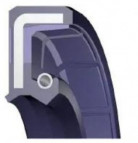
The TCN oil seal has a shorter primary lip supported by a garter spring. This helps the sealing lip remain axially and radially stable when pressure increases. The shorter lip geometry reduces the risk of lip deformation compared with the longer lip of a standard TC oil seal.
The secondary dust lip does not seal pressure, but helps protect the primary sealing area against contamination from outside the application. The fully elastomer-coated outer diameter provides static sealing in the housing and helps prevent fretting corrosion between the seal and housing.
The pressure resistance of a TCN oil seal comes from the geometry of the sealing lip. The short, pressure-loadable lip is supported by a garter spring, which creates a stable contact line between the lip and the shaft.
This design helps the lip maintain contact under internal pressure. It also makes the TCN profile suitable for viscous and low-viscosity media. In specific cases, a TCN oil seal can also be used for gaseous media, provided that pressure, speed, temperature and heat generation remain within suitable limits.
The elastomer-coated outer diameter makes the TCN oil seal suitable for applications where static sealing in the housing is important. This can be relevant in aluminum housings, split housings and refurbished hydraulic pumps or motors.
TC and TCN oil seals are both rotary shaft seals, but they are used under different operating conditions. A standard TC oil seal is mainly used in pressure-free or splash-lubricated applications. A TCN pressure oil seal is used when internal pressure is present and the sealing lip must remain stable under pressure.
The TCN profile has a shorter, pressure-loadable primary lip supported by a garter spring. This helps the contact line between the lip and the shaft remain stable when pressure increases. The secondary dust lip helps protect the sealing area against contamination, but it does not seal pressure.
| Oil seal type | Use this type when... |
|---|---|
| TC oil seal | The application is pressure-free or splash-lubricated and a standard rotary shaft oil seal is sufficient. |
| TCN pressure oil seal | The application involves internal pressure and requires a pressure-loadable sealing lip. |
Choose a TCN pressure oil seal when the original seal specification calls for a TCN profile or when the application involves internal pressure around a rotating shaft. The TCN profile is commonly used when reliable lubricant retention and pressure stability are important.
Typical applications include hydraulic pumps, hydraulic motors, gear pumps, vane pumps, orbit motors, compact hydraulic units, power packs and mobile machinery. TCN oil seals are also used in industrial drives and transmissions where local pressure build-up can occur due to temperature increase, limited venting or low-viscosity lubricants.
The right choice depends on the shaft diameter, housing bore, seal width, medium, temperature, pressure, shaft speed and material compatibility. At higher rotational speeds, the permissible pressure decreases. Always check the pressure and speed limits before selecting a TCN oil seal.
TCN oil seals are used where a compact rotary shaft seal must handle more pressure than a standard TC oil seal. The pressure-loadable lip makes the TCN profile suitable for hydraulic and industrial sealing applications, provided that the operating conditions remain within the correct limits.
The material of a TCN pressure oil seal determines whether the seal is suitable for the medium, temperature and operating environment. NBR is commonly used for mineral oils, greases and general hydraulic applications. FKM/Viton is used for higher temperatures and more demanding chemical conditions.
Other materials such as HNBR, ACM, CR, EPDM and silicone may be used when the application has specific media, temperature or mechanical requirements. The spring and reinforcing ring can also be supplied in stainless steel when corrosion resistance is required.
| Material | Typical temperature range | Key properties |
|---|---|---|
| NBR (Nitrile Rubber) | -30 °C to +100 °C | Good wear resistance, suitable for mineral oils and greases, cost-effective. Recommended maximum of 80 °C with synthetic oils. |
| FKM / Viton | -20 °C to +180 °C | Excellent heat resistance and chemical resistance. Suitable for synthetic oils and more demanding media. |
| HNBR | -30 °C to +150 °C | Improved mechanical strength, pressure resistance and wear resistance compared with NBR. |
| ACM | -20 °C to +150 °C | Good resistance to hot oils and oxidation, with moderate low-temperature performance. |
| CR | -30 °C to +120 °C | Balanced oil and weather resistance with moderate mechanical properties. |
| EPDM | -40 °C to +150 °C | Excellent resistance to water, steam and brake fluids. Not suitable for mineral oils. |
| Silicone | -60 °C to +200 °C | Very wide temperature range and good low-temperature flexibility, but limited wear resistance and pressure capability. |
Selecting the right TCN oil seal starts with the shaft diameter, housing bore and seal width. The operating conditions are just as important. Pressure, rotational speed, temperature, medium, lubrication and heat dissipation all influence whether a TCN pressure oil seal is the correct choice.
For reliable sealing, the shaft should comply with ISO h11 tolerances, have a torsion-free surface and sufficient hardness. The housing is typically manufactured to ISO H8 tolerances. A shaft surface roughness of Ra 0.2–0.8 µm with a lead-free finish and a housing bore roughness of Ra 1.6–6.3 µm help the TCN seal maintain stable contact with the shaft and reliable static sealing in the housing.
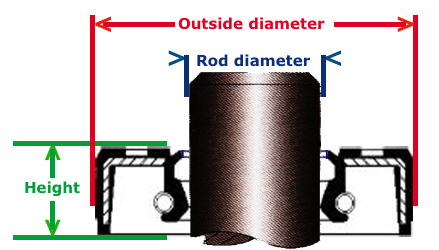
Use the product filters above to find the correct TCN oil seal by inside diameter, outside diameter, width and material. If the required size or material is not listed, contact us to check availability or a suitable alternative.
A TCN pressure oil seal can handle several bar of pressure at low rotational speeds. The permissible pressure decreases as rotational speed increases. The right seal choice therefore depends on the combination of shaft diameter, rotational speed and pressure.
| Rotational speed | Shaft Ø 20 mm | Shaft Ø 40 mm | Shaft Ø 80 mm |
|---|---|---|---|
| 0 rpm | 10.0 bar | 8.5 bar | 7.0 bar |
| 500 rpm | 10.0 bar | 8.5 bar | 5.0 bar |
| 1000 rpm | 5.5 bar | 4.5 bar | 3.0 bar |
| 2000 rpm | 3.0 bar | 2.5 bar | 1.5 bar |
| 3000 rpm | 2.0 bar | 1.5 bar | 0.3 bar |
| 4000 rpm | 1.2 bar | 0.5 bar | 0.0 bar |
| 5000 rpm | 0.7 bar | 0.0 bar | - |
| 6000 rpm | 0.0 bar | - | - |
Different manufacturers and suppliers may use different references for comparable high pressure rotary shaft seals. These references are useful when replacing an existing seal, converting a manufacturer code or finding a TCN equivalent.
Common TCN oil seal references include WASY, OS-N11, TR-U, RST-D, GAP, BAB SL, 827 SK, DGSP, BABSL, CF, TCV / TCN and KAS-P. Always check the shaft diameter, housing bore, seal width, material and operating conditions before selecting a replacement seal.
| Manufacturer / supplier | Reference for comparable high pressure oil seal |
|---|---|
| Dichtomatik | WASY |
| Anyseals | OS-N11 |
| B+S | TR-U |
| Eriks | RST-D |
| FP Paris | GAP |
| FST | BAB SL |
| Goetze | 827 SK |
| Kaco | DGSP |
| Kramp | BABSL |
| Stefa | CF |
| Taiwan / NOK | TCV / TCN |
| Vota | BAB SL |
| Kimman | KAS-P |
If you are not sure which TCN oil seal size, material or pressure rating you need, our specialists can help you check the options. Share the shaft diameter, housing bore, seal width, medium, temperature, pressure and rotational speed, and we will help you find a suitable TCN pressure oil seal.
A TCN pressure oil seal is a rotary shaft seal with a pressure-loadable sealing lip. It is used when internal pressure is present and a standard TC oil seal does not provide sufficient sealing reliability.
A TC oil seal is used for standard rotary shaft sealing in pressure-free or splash-lubricated applications. A TCN oil seal is selected when the shaft seal is exposed to internal pressure.
Choose a TCN oil seal when the original specification calls for a TCN profile or when the application involves internal pressure, such as in hydraulic pumps, hydraulic motors, gear pumps, vane pumps or compact hydraulic units.
Common references for comparable high pressure rotary shaft seals include WASY, OS-N11, TR-U, RST-D, GAP, BAB SL, 827 SK, DGSP, BABSL, CF, TCV / TCN and KAS-P. Always check the dimensions, material and operating conditions before selecting a replacement.
Only within the permitted pressure and speed limits. As rotational speed increases, the pressure capacity of a TCN oil seal decreases. For high speed and high pressure at the same time, another sealing concept may be required.
Yes, in specific cases this is possible at low pressure and low speed because of the stable lip design. The medium, temperature, speed and heat generation must always be checked before selection.
Yes. The elastomer-coated outer diameter makes TCN oil seals suitable for aluminum housings and split housings, where housing variation, thermal expansion or fretting corrosion may be a concern.
Yes. TCN oil seals are commonly available in NBR and FKM/Viton. Other materials such as HNBR, ACM, CR, EPDM and silicone may be available depending on the application and required operating conditions.