5.500.000+ parts in stock
Fast delivery



The Domsel A-SF oil seal is a radial shaft seal for rotating shafts, intended to reliably retain media such as oil and grease and to keep contamination out. Where a “standard” oil seal can sometimes run hot quickly or start leaking unstably at higher speeds or pressure, the A-SF was developed as a high-performance alternative with a narrow design. This makes the seal interesting when you have limited axial installation space, but still need stable sealing under demanding conditions. In practice, the A-SF is therefore used in compact bearing housings, drives, and machine components where speeds increase and downtime due to leakage has a direct impact.
The A-SF is designed to combine low friction with stable lip sealing. The principle is still that the sealing lip applies a controlled contact pressure on the shaft surface, but Domsel positions this series as more efficient than many classic lip seals: less friction generally means less frictional heat, which is beneficial for service life, the lubrication film, and the shaft running surface. In addition, A-SF is specifically a narrow design: you gain installation space without immediately compromising performance. A practical advantage that is often mentioned with this design principle is that the seal can be more shaft-friendly in many applications, provided the shaft finish and lubrication are correct. Within the A-SF family, variants are also supplied in different material combinations (elastomer and metal), so you can match the seal to the medium, temperature, cleaning, and chemistry.
You mainly encounter Domsel A-SF in applications where space and performance are important at the same time. Think of engines, gearboxes, spindles, pumps, compressors, fans, and a wide range of vehicle and machine-building applications. The reason is simple: you have a rotating shaft with a medium you want to keep inside, while the operating conditions (speed, temperature, pressure, contamination) make it more difficult for standard solutions. In pump and compressor environments, a combination of speed and pressure often plays a role. In spindles and fans, high circumferential speed and low friction are the key theme, because heat management and energy loss become noticeable quickly. And in compact reducers or bearing housings, the slim design is often decisive: you do not want to design a larger housing just to fit a standard oil seal.
The choice of material largely determines whether the A-SF runs “worry-free” in practice or quickly develops problems. Broadly speaking, you look at two material groups: the elastomer (the sealing lip and any static seal) and the metal support/fitting parts.
NBR is a logical basic choice in many oil and grease applications because it is widely usable and performs well with standard industrial lubrication. The weak point mainly lies in higher temperatures and certain chemicals: with a lot of heat, NBR can harden faster, making the seal more prone to leakage over time.
HNBR is interesting when you want just a bit more margin than NBR, for example due to higher operating temperature, higher load, or wear caused by fine particles. The material is mechanically robust and often more wear-resistant, but it still needs to be matched to the medium if you are dealing with aggressive chemicals or special cleaning agents.
FKM (FPM) is generally the “next step” when temperature and chemical resistance start to matter more. It is often a safe choice at higher temperatures and with a broader mix of media. The pitfall is that not every FKM variant handles, for example, steam, alkalis, or certain cleaning chemistry well; therefore, checking compatibility is important, especially in food/pharma or process industry.
You choose EPDM when your environment shifts more toward water, steam, and specific chemicals where NBR and standard FKM are less logical. The major weak point is that EPDM does not combine well with mineral oils and greases; in a classic oil application, EPDM is therefore usually the wrong choice.
FFKM is the material for exceptional situations: extreme chemistry and/or very high temperatures where other elastomers do not cope. The strengths are clear, but in practice FFKM is only logical if the application truly requires it, because it is usually a costly route.
VMQ (silicone) is mainly chosen for applications where low-temperature flexibility and temperature cycling are important, because it stays compliant in the cold. The trade-off is that VMQ is generally less mechanically strong and less wear-resistant than many other elastomers, so it can wear faster in heavily loaded or abrasive dynamic duties. As always, make sure the compound is compatible with your medium and cleaning chemistry.
For the metal parts, the general rule is: steel is fine for general industrial environments, while stainless steel is more logical in corrosive environments, food/pharma cleaning, or applications where you want maximum chemical resistance on the outside.
|
Material |
Temp. range (°C) |
Key properties |
Strong in |
Weak / watch-outs |
|
NBR |
approx. -30 to +90 (food-grade variants up to +120) |
Allround for oil/grease, good price/performance |
Mineral oils, greases, air; many standard applications |
Less suitable at high temperature and with certain chemicals |
|
HNBR |
approx. -35 to +140 |
More wear-resistant/robust than NBR |
Harsher conditions, abrasive particles, higher temp than NBR |
Check compatibility for aggressive chemistry (compound-dependent) |
|
FKM / FPM |
approx. -10 to +210 |
High temp + broad chemical resistance |
High temperature, many oil/chemistry applications |
Standard FPM is not always suitable for steam/alkali; always check medium/cleaning |
|
EPDM |
approx. -45 to +130 |
Strong in water/chemistry profiles where NBR/FKM are less logical |
Water/alkali-like media, steam-like environments (compound-dependent) |
Not suitable for mineral oils/greases |
|
FFKM |
approx. -10 to +230 (variants up to +300) |
Maximum chemical + thermal margin |
Extreme chemistry and high temperatures |
Often costly; usually only makes sense if FKM falls short |
|
VMQ |
approx. -40 to +200 |
Very flexible at low temperature |
Cold environments, temperature cycling |
Mechanically less strong/wear-resistant; check dynamic duty and medium compatibility |
|
Metal |
Key properties |
When to choose |
|
Steel |
Standard industrial, strong |
General machine building, non-corrosive |
|
Stainless steel |
More corrosion-resistant |
Corrosive environment, food/pharma cleaning, humid/chemical environment |
If you compare the Domsel A-SF with the Domsel A and Domsel AB, the main differences come down to design envelope (installation space) and lip configuration / application focus. The Domsel Seal A is the “base” version within this high-performance line: a radial shaft seal in which the sealing lip aligns with the pressing direction, intended for regular sealing duties in rotating machinery. The Domsel Seal AB is built within the same family, but it is clearly positioned for compressed air and gases and for difficult, low-lubrication grease sealing points; its construction is described in terms of sealing lips that are aligned with the press-in direction, so the lip direction is comparable to the A, but with a different functional focus. The Domsel Seal A-SF is the option you choose when axial installation space is tight: it features a narrow design and can be pressed in from both directions, giving you more mounting flexibility in compact housings while staying within the same high-performance approach.
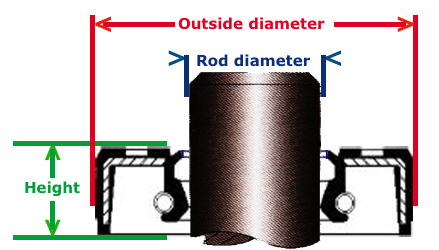
When selecting the size, you start with the shaft diameter (d) and the bore/housing dimensions (D), plus the available installation width (b). For Domsel A-SF, it is especially important not to order “by feel” as with standard DIN oil seals, but to base your choice on the Domsel size list for A-SF: per size it shows the exact geometry and widths. Also check which side the medium is on, what the pressure direction is, and whether your application requires additional retention at higher pressure.
Next, you look at the quality of the counterface, because a lip seal is only as good as the shaft surface. In practice, this means you want a neatly ground, twist-free running surface with a roughness that matches the operating conditions, and edges that are rounded and deburred so you do not damage the lip during installation. At higher speeds and with critical leakage requirements, it pays to be stricter on roughness and geometry, because the lubrication film and frictional heat reach their limits more quickly. In the market, you often see references to DIN 3760 and ISO 6194 for classic oil seals, but with Domsel the “practical standardization” mainly comes down to correctly following their design and size specifications combined with a shaft and housing finish that is right.
You then choose the material based on the medium, temperature (continuous and peaks), speed and pressure, and the environment or cleaning. In oil and grease applications, you often end up with NBR or HNBR, with HNBR being extra interesting under harsher conditions or abrasive influences. As soon as temperature and chemistry become more demanding, FKM is usually the safe choice. FFKM only comes into play if FKM demonstrably falls short. EPDM is mainly relevant when oil/grease is not part of the application and you are dealing with water, steam, or specific chemicals instead.
When it comes to sealing rotating machine parts in tight installation conditions, the Domsel Seal A-SF is a reliable choice that offers superior performance and durability. Its low frictional torque, high chemical resistance, and wide temperature range make it a versatile solution for various industries. Trust the Domsel Seal A-SF to deliver efficient and long-lasting sealing in your machinery applications.
If you want more information, or do you have any questions, feel free to contact us.
A-SF is a Domsel design type within radial shaft seals, focused on a narrow design for tight installation and high-performance sealing.
When you have limited installation space, higher speeds or pressure, or when your current seal runs hot or starts leaking unstably.
A-SF is often chosen when pressure plays a role. The exact limit depends on size, design, installation, and operating conditions.
For oil and grease, NBR is often all-round. For higher temperatures and broader chemical resistance, FKM is usually the safe choice. The best choice still depends on your medium and cleaning.
With lip damage due to sharp edges, the wrong installation tool, insufficient lubrication during installation, or a shaft surface that is not suitable (too rough or with “twist”).