
| Product | Product Id | Type | Rotation | Inside Diameter | Outer Diameter | Height | Material | Housing Material | Material Spring | Spring | Dust lip | Color | Stock | Price | ||
|---|---|---|---|---|---|---|---|---|---|---|---|---|---|---|---|---|
|
48075 | Oil Seal | 6 | 18 | 8 | NBR - Nitrile | Steel | Steel | Yes | No | Black | 69 | € 3,38 | Details | ||
|
|
48067 | Oil Seal | 58 | 80 | 12 | NBR - Nitrile | Steel | Steel | Yes | No | Black | 276 | € 8,68 | Details | ||
|
48066 | Oil Seal | 30 | 45 | 12 | FPM - VITON | Steel | Steel | Yes | No | Brown | 146 | € 20,25 | Details | ||
|
|
48045 | Oil Seal | 55 | 82 | 14.5 | NBR - Nitrile | Steel | Steel | Yes | No | Black | 365 | € 9,31 | Details | ||
|
|
48037 | Oil Seal | 55 | 75 | 15 | NBR - Nitrile | Steel | Steel | Yes | No | Black | 278 | € 8,11 | Details | ||
|
|
48025 | Oil Seal | 55 | 100 | 13 | NBR - Nitrile | Steel | Steel | Yes | No | Black | 0 | € 11,67 | Details | Quote | |
|
|
48024 | Oil Seal | 55 | 100 | 13 | FPM - VITON | Steel | SS-304 | Yes | No | Brown | 0 |
Request
|
Details | Quote | |
|
|
48004 | Oil Seal | 52 | 85 | 10 | NBR - Nitrile | Steel | Steel | Yes | No | Black | 9 | € 9,29 | Details | ||
|
|
47998 | Oil Seal | 52 | 72 | 12 | NBR - Nitrile | Steel | Steel | Yes | No | Black | 186 | € 8,11 | Details | ||
|
|
47997 | Oil Seal | 52 | 72 | 12 | FPM - VITON | Steel | SS-304 | Yes | No | Brown | 70 | € 21,68 | Details | ||
|
|
47982 | Oil Seal | 50 | 80 | 15 | NBR - Nitrile | Steel | Steel | Yes | No | Black | 161 | € 8,68 | Details | ||
|
|
47981 | Oil Seal | 50 | 80 | 13 | NBR - Nitrile | Steel | Steel | Yes | No | Black | 315 | € 8,68 | Details | ||
|
|
47975 | Oil Seal | 25.4 | 44.45 | 7.93 | FPM - VITON | Steel | Steel | Yes | No | Brown | 575 | € 20,25 | Details | ||
|
|
47972 | Oil Seal | 50 | 72 | 15 | NBR - Nitrile | Steel | Steel | Yes | No | Black | 0 | € 8,11 | Details | Quote | |
|
|
47971 | Oil Seal | 50 | 72 | 13 | NBR - Nitrile | Steel | Steel | Yes | No | Black | 215 | € 8,11 | Details | ||
|
|
47970 | Oil Seal | 50 | 72 | 13 | FPM - VITON | Steel | SS-304 | Yes | No | Brown | 140 | € 21,68 | Details | ||
|
|
47966 | Oil Seal | 50 | 72 | 10 | NBR - Nitrile | Steel | Steel | Yes | No | Black | 486 | € 8,11 | Details | ||
|
|
47964 | Oil Seal | 50 | 70 | 8 | NBR - Nitrile | Steel | Steel | Yes | No | Black | 164 | € 7,50 | Details | ||
|
|
47953 | Oil Seal | 101.6 | 127 | 12.7 | NBR - Nitrile | Steel | Steel | Yes | No | Black | 136 | € 16,49 | Details | ||
|
|
47950 | Oil Seal | 38.1 | 63.5 | 18.64 | NBR - Nitrile | Steel | Steel | Yes | No | Black | 315 | € 7,09 | Details | ||
|
|
47949 | Oil Seal | 50 | 65 | 10 | NBR - Nitrile | Steel | Steel | Yes | No | Black | 644 | € 7,09 | Details | ||
|
|
47942 | Oil Seal | 50 | 110 | 12 | NBR - Nitrile | Steel | Steel | Yes | No | Black | 324 | € 13,66 | Details | ||
|
|
47932 | Oil Seal | 48 | 72 | 15 | NBR - Nitrile | Steel | Steel | Yes | No | Black | 0 | € 8,11 | Details | Quote | |
|
|
47931 | Oil Seal | 48 | 72 | 11 | NBR - Nitrile | Steel | Steel | Yes | No | Black | 3538 | € 8,11 | Details | ||
|
|
47929 | Oil Seal | 48 | 65 | 12 | NBR - Nitrile | Steel | Steel | Yes | No | Black | 157 | € 7,09 | Details | ||
|
|
47926 | Oil Seal | 48 | 62 | 8 | NBR - Nitrile | Steel | Steel | Yes | No | Black | 255 | € 7,09 | Details | ||
|
|
47924 | Oil Seal | 48 | 58 | 10 | NBR - Nitrile | Steel | Steel | Yes | No | Black | 16 | € 6,25 | Details | ||
|
|
47909 | Oil Seal | 45 | 88.9 | 19 | NBR - Nitrile | Steel | Steel | Yes | No | Black | 270 | € 10,13 | Details | ||
|
|
47907 | Oil Seal | 45 | 85 | 10 | NBR - Nitrile | Steel | Steel | Yes | No | Black | 9 | € 9,29 | Details | ||
|
|
47898 | Oil Seal | 45 | 70 | 15 | NBR - Nitrile | Steel | Steel | Yes | No | Black | 151 | € 7,50 | Details |
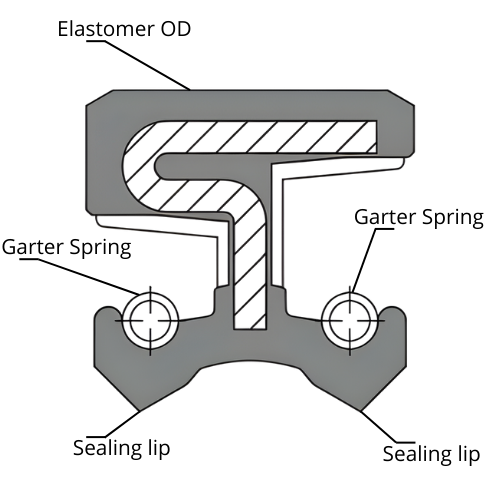
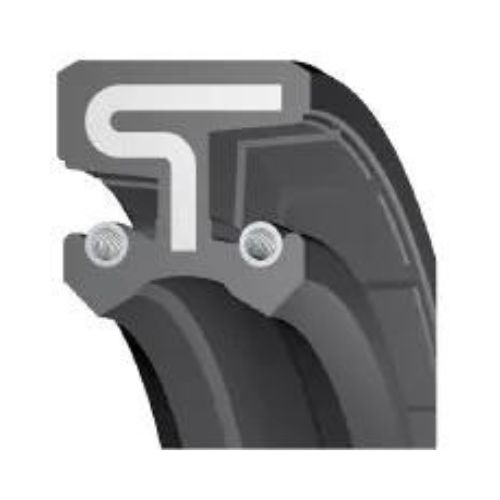
The operation of the DC oil seal is directly derived from its construction. The design consists of two full-function sealing lips, each supported by its own garter spring. These springs provide constant and controlled radial pressure on the shaft, ensuring that the sealing lips maintain their sealing function even in case of wear, temperature fluctuations, or minor shaft movements. Because both lips are actively sealing, a stable sealing is created on both sides of the seal, preventing leakage in both directions and minimizing cross-contamination between media.
The outer diameter of the oil seal DC is fully elastomer-coated and is supplied with a smooth finish as standard. This elastic outer jacket serves multiple functions simultaneously: it provides reliable static sealing in the housing, compensates for bore tolerances, and absorbs thermal expansion of the housing, particularly in light-metal housings. In addition, the rubber coating makes the seal suitable for bores with increased surface roughness and for split housings, while eliminating the risk of fretting corrosion.
Internally, the seal is equipped with a metal reinforcing ring that ensures geometric stability. This ring prevents deformation during installation and operation, promotes uniform distribution of sealing forces, and contributes to a repeatable and secure installation position. Together, these structural elements form a seal that is mechanically stable, tolerant of dimensional variations, and capable of long-term reliable performance in demanding applications.
The DC oil seal is used in applications where functional separation is more important than simple leakage prevention. Typical applications include rotating machine elements where two different media are present on either side of the seal, such as two types of lubricating oil, oil and grease, or a wet side and a dry side. Examples include combined gear-and-bearing arrangements, pump shafts with separated lubrication zones, and drive units where different oil circuits must remain isolated. Thanks to the dual sealing lips, a single oil seal can reliably perform this separation.
In addition, this type is particularly suitable for housings with high thermal expansion, such as light-metal housings, split housings, or older constructions with less precise bore geometry, as found in industrial gearboxes, auxiliary drives, and retrofitted machinery. In such situations, the elastomer-coated outer diameter prevents both leakage and fretting corrosion.
Material selection largely determines the applicability of the DC oil seal. NBR (70 Shore A) is the standard material and offers a good balance between wear resistance, elasticity, and resistance to mineral oils and greases. The material is suitable for a wide temperature range but has limitations when exposed to prolonged high temperatures and ozone. FKM is selected when higher temperatures or chemically aggressive media are involved; the material is highly stable but less flexible at low temperatures and more expensive. HNBR provides improved heat and aging resistance compared to NBR while maintaining mechanical strength. ACM is suitable for hot engine and transmission oils but performs less well at low temperatures. Silicone is chosen for extreme temperature conditions, while CR and EPDM are used only in specific niche applications depending on the medium. Stainless-steel versions of the spring and reinforcing ring are also available when corrosion resistance is required. As standard, the spring is manufactured from spring steel in accordance with DIN EN 10270-1, while the reinforcing ring is produced from sheet steel in accordance with DIN EN 10139.
| Material | Maximum Temperature | Key Properties |
|---|---|---|
| NBR | +100 °C | Oil & grease resistant, Good wear resistance, Cost-effective, Limited ozone & heat resistance |
| FKM | +200 °C | High-temperature resistant, Excellent chemical resistance, Fuel resistant, Higher cost, Reduced low-temperature flexibility |
| HNBR | +150 °C | Improved heat resistance, Ozone resistant, High mechanical strength, Good oil compatibility |
| ACM | +150 °C | Hot oil resistant, Good aging stability, Oxidation resistant, Limited low-temperature performance |
| VMQ | +200 °C | Wide temperature range, Excellent low-temperature flexibility, Low friction, Lower wear resistance |
| CR | +110 °C | Weather resistant, Ozone resistant, Moderate oil resistance |
| EPDM | +140 °C | Heat & steam resistant, Excellent aging resistance, Not oil resistant |
Within the range of radial shaft seals, the DC oil seal occupies a clearly defined functional position. Unlike SC oil seals, which are equipped with a single sealing lip for one-sided sealing, and TC oil seals, which combine a sealing lip with a dust lip for external contamination protection, the oil seal DC features two actively sealing lips, each supported by its own spring. As a result, the DC rotary shaft seal is not primarily focused on excluding external contamination but on reliably separating two media within a single assembly.
Compared with DB designs, which also have a double sealing lip but use a metal outer diameter, the oil seal DC variant offers greater operational reliability in housings with tolerances, split housings, or thermal movement. The elastomer-coated outer diameter compensates for dimensional variations and prevents leakage along the outside diameter, where metal-cased versions are more likely to encounter fitment issues or fretting. The DC type rotor seal is therefore not a replacement for other oil seal types, but a specific sealing solution for applications where media separation, tolerance compensation, and installation reliability are more critical than in standard applications.
Correct selection of a DC oil seal requires consideration of both dimensional requirements and operating parameters. The DC oil seal is designed for pressureless applications, with a maximum permissible operating pressure of approximately 0.02 MPa. The shaft must match the ISO h11 tolerance, with a minimum hardness of 45 HRC and a torsion-free surface finish within the specified roughness limits. In addition, the maximum peak-to-valley roughness of the shaft surface should not exceed Rmax 6.3 μm. For the housing, ISO H8 is typically applied; the elastomer-coated outer diameter makes the rotary shaft seal DC suitable for bores with increased surface roughness. In addition, temperature, rotation speed (maximum approximately 5 m/s for standard materials), and the operating medium must be carefully evaluated. When using synthetic lubricants without proven field experience, compatibility testing is recommended, with operating temperatures preferably kept below 80 °C. Correct installation in accordance with specifications is essential to fully realize the sealing performance.
To assist with product identification and replacement, a cross reference table is provided below, showing equivalent oil seal DC designs from various manufacturers.
| Manufacturer | DC Oil Seal Reference |
|---|---|
| Dichtomatik | WAD |
| Anyseals | OS-D10 |
| Chicago Rawhide (SKF) | DUPLEX |
| Elring | AD |
| ERIKS | R-DUO |
| FP Paris | G2 |
| FST | BA DUO |
| Goetze | 827 D |
| KACO | DGD |
| Kramp | CBD |
| Paulstra | IELR |
| Pioneer Western | R22 |
| Rolf | RD |
| Stefa (Trelleborg) | CK |
| NOK / Taiwan NOK | DC |
| Vota | BA DUO |
| Ebele | R-DUO |
| Kimman | KA-DUO |
No, it is designed for pressureless applications up to approximately 0.02 MPa.
To ensure reliable static sealing, compensate for tolerances, and prevent fretting corrosion.
Didn't find the right Oil Seal DC - Rotary Shaft Seal?
Complete the form below and we will help you!